
NIFT Coaching in Bangalore 2027-2028
1 NIFT Coaching in Bangalore 2027 – 2028 at BRDS
Preparing for the National Institute of Fashion Technology (NIFT) requires more than practising fashion sketches. Aspirants need to develop creative thinking, visualisation, observation, design awareness, quantitative and logical reasoning, and the ability to communicate ideas within a fixed time. For students looking for NIFT Coaching in Bangalore, BRDS offers classroom-based options at multiple locations across the city for structured design entrance preparation and practice.
BRDS currently lists Malleswaram, Jayanagar, and Indiranagar among its Bangalore centres. Students can choose the location that best fits their daily travel and preparation schedule. Current centre details, batch timings, and programme availability should be confirmed directly with BRDS before enrolment.
The Malleswaram centre is listed at No. 139, 2nd Floor, 8th Main, between 13th and 15th Cross, Malleswaram, Bangalore, Karnataka 560055.
The Jayanagar centre is listed at No. 779 & 780, 4th Floor, Sai Tower, CNR Colony, South End Main Road, Jayanagar 9th Block, Bengaluru 560069.
The Indiranagar centre is listed at 2nd Floor, 488 Chinmaya Mission Hospital Road, 1st Stage, opposite Fabindia, Indiranagar, Bangalore, Karnataka 560038.
NIFT admissions are conducted through the National Institute of Fashion Technology Entrance Examination (NIFTEE). For the 2026 admission cycle, B.Des. admissions involved the General Ability Test (GAT) and Creative Ability Test (CAT), followed by the Situation Test for shortlisted candidates. The exact examination structure and selection requirements should always be checked against the admission cycle for which a student is applying.
At BRDS, NIFT preparation can cover areas relevant to the entrance process, including aptitude practice, sketching, creative ideation, visual communication, mock tests, time-bound exercises, and Situation Test preparation. Course structure, batch schedules, materials, and current inclusions can vary by programme and should be confirmed with BRDS.
For students comparing NIFT Coaching in Bangalore, the city also offers a rich everyday environment for observation-based design practice. Its commercial streets, public spaces, technology-driven environments, traditional markets, cultural institutions, and craft influences can encourage students to observe products, clothing, materials, signage, architecture, movement, and user behaviour.
BRDS provides Offline, Live Online and Hybrid NIFT Coaching Classes for the NIFT Entrance Exam 2027-2028. BRDS offers separate Coaching programmes for both UG and PG aspirants. Students can enrol for Regular, Weekend or Crash Courses as per their academic schedules.
- Students in Class 9, 10 & 11 can select the Foundation Course for NIFT B.Des (Group A)
- Students in Class 12 or 12th-passed can select the NIFT B.Des / B.F.Tech Course (Group B)
- Post graduate students can choose the NIFT M.Des, M.F.M or M.F.Tech Course (Group E or F)
2 NIFT Entrance Exam Coaching – Courses offered by BRDS
NIFT – Foundation Coaching
NIFT B.Design Coaching
NIFT B.FTech Coaching
3 Important Information about NIFT
About NIFT
NIFT has 20 campuses across India and offers undergraduate, postgraduate and doctoral programmes in design, technology and management.
Admission to NIFT for the academic session 2027–28 is conducted through the NIFT Entrance Examination (NIFTEE) 2027, administered by the National Testing Agency (NTA).
NIFT Undergraduate Programmes
- Bachelor of Design (B.Des) – Fashion Design, Fashion Communication, Textile Design, Accessory Design, Knitwear Design, Leather Design, Fashion Interiors
- Bachelor of Fashion Technology (B.F.Tech) – Apparel Production
Duration: 4 Years
NIFT Postgraduate Programmes
- Master of Design (M.Des)
- Master of Fashion Management (M.F.M)
- Master of Fashion Technology (M.F.Tech)
Duration: 2 Years
NIFT 2027 – Seat Availability
NIFT offers 5,076 seats across its undergraduate and postgraduate programmes for the academic session 2027–28, including 480 state domicile seats.
Note: Programme-wise and campus-wise seat availability varies. Additional supernumerary seats may be available under applicable admission categories.
NIFT 2027 Important Dates
NIFT UG, PG and NLEA – Important Dates
| Activity | Date |
| Online Registration Begins | 16 Oct 2026 |
| Last Date to Apply | 16 Nov 2026 |
| Last Date with ₹5,000 Late Fee | 21 Nov 2026 |
| Application Correction Window | 22–25 Nov 2026 |
| Advance City Intimation Slip | 21 Dec 2026 |
| Admit Card Release | 4 Jan 2027 |
| NIFT Entrance Exam 2027 | 10 Jan 2027 |
| Answer Key and Recorded Responses | To Be Announced |
| Stage 1 Result | Feb/Mar 2027 |
| Situation Test / Studio Test / Interview | Mar/Apr 2027 |
| Final Result | First Week of May 2027 |
| Seat Allocation | May/Jun 2027 |
NIFT B.Des Artisan Category – Important Dates
| Activity | Date |
| Online Registration Begins | 16 Oct 2026 |
| Last Date to Apply | 31 Jan 2027 |
| Application Correction Window | 1–4 Feb 2027 |
| Admit Card Release | Mar 2027 |
| Artisan Skill Test and Personal Interview | Apr 2027 |
| Final Result | First Week of May 2027 |
| Seat Allocation | May/Jun 2027 |
NIFT NRI / Foreign National / OCI / SAARC – Important Dates
| Activity | Date |
| Online Registration Begins | 16 Oct 2026 |
| Last Date to Apply | 31 Mar 2027 |
| Last Date for SAT / GMAT / GRE Scores | 31 Mar 2027 |
| Application Correction Window | 1–4 Apr 2027 |
| Seat Allotment and Fee Payment | May 2027 |
NIFT Entrance Exam 2027 – Eligibility Criteria
NIFT Undergraduate Programmes
Educational Qualifications
1. Bachelor of Design (B.Des)
Class 12 or an equivalent recognised qualifying examination from any stream. Other accepted qualifications include eligible diplomas.
2. Bachelor of Fashion Technology (B.F.Tech)
Class 12 or an equivalent recognised qualifying examination with Mathematics, or an eligible engineering diploma as prescribed in the admission guidelines.
Age Limit
For undergraduate programmes, candidates must be less than 24 years of age as of 1 August 2027. A relaxation of five years is applicable to eligible SC/ST/PwD/PwBD candidates.
NIFT Postgraduate Programmes
Educational Qualifications
1. Master of Design (M.Des)
Undergraduate degree in any discipline from a recognised institution, or a minimum three-year undergraduate diploma from NIFT/NID.
2. Master of Fashion Management (M.F.M)
Undergraduate degree in any discipline from a recognised institution, or a minimum three-year undergraduate diploma from NIFT/NID.
3. Master of Fashion Technology (M.F.Tech)
B.F.Tech from NIFT or B.E./B.Tech from a recognised institution.
Age Limit
There is no prescribed age limit for postgraduate programmes.
Candidates appearing for their qualifying examinations may also apply, subject to the conditions for provisional admission and submission of the required documents.
Other NIFT Admission Categories
NIFT also offers admission through the following categories, subject to their respective eligibility criteria:
- NIFT Lateral Entry Admission (NLEA): For eligible candidates seeking lateral entry into B.Des or B.F.Tech programmes.
- Artisan Category: For eligible candidates applying to B.Des through the Artisan admission route.
- NRI / Foreign National / OCI / SAARC: For eligible candidates applying through the prescribed international admission categories.
Candidates should refer to the official NIFT Admission Prospectus 2027 for detailed eligibility requirements and accepted qualifications.
NIFT Entrance Exam 2027 – Exam Pattern
The GAT is conducted in Computer-Based Test (CBT) mode, while the CAT is conducted in Paper-Based Test (PBT) mode.
NIFT 2027 Exam Pattern and Weightage
| Programme | Examination Component | Weightage |
| B.Des | GAT | 30% |
| CAT | 50% | |
| Situation Test | 20% | |
| B.F.Tech | GAT Section A | 30% |
| GAT Section B | 70% | |
| M.Des | GAT Section A | 30% |
| CAT | 40% | |
| Personal Interview | 30% | |
| M.F.M | GAT Sections A & B | 70% |
| Personal Interview | 30% | |
| M.F.Tech | GAT | 70% |
| Personal Interview | 30% |
NIFT 2027 Exam Duration and Number of Questions
| Programme | Test | Duration | Questions |
| B.Des | GAT | 2 Hours | 100 |
| CAT | 3 Hours | 3 | |
| B.F.Tech | GAT | 3 Hours | 150 |
| M.Des | GAT | 2 Hours | 120 |
| CAT | 3 Hours | 3 | |
| M.F.M | GAT | 3 Hours | 150 |
| M.F.Tech | GAT | 3 Hours | 150 |
NIFT 2027 Marking Scheme
| Response | Marks |
| Correct Answer | +1 |
| Incorrect Answer | −0.25 |
| Unattempted Question | 0 |
NIFT Situation Test 2027 – B.Des
Shortlisted B.Des candidates must appear for the Situation Test, which` evaluates their ability to create three-dimensional models using the materials provided.
The evaluation considers creativity, material handling, space visualisation, colour scheme, model construction and overall presentation. Candidates must also provide a written explanation of their concept in English.
NIFT Personal Interview 2027 – PG Programmes
Shortlisted M.Des, M.F.M and M.F.Tech candidates must appear for the Personal Interview.
The interview evaluates programme suitability, career orientation, academic background, subject knowledge, creativity and communication skills.
NIFT Lateral Entry Admission (NLEA) 2027 – Selection Process
NIFT Lateral Entry Admission (NLEA) allows eligible candidates to seek admission into the third semester of undergraduate programmes, subject to the prescribed eligibility criteria and seat availability.
| Programme | Examination Component | Weightage |
| B.Des – NLEA | GAT | 40% |
| Studio Test | 40% | |
| Personal Interview | 20% | |
| B.F.Tech – NLEA | GAT | 40% |
| Technical Ability Test (TAT) | 40% | |
| Personal Interview | 20% |
Seat Availability: 401 tentative NLEA seats for 2027. Final seat availability depends on vacancies and applicable admission procedures.
NIFT B.Des Artisan Category – Selection Process 2027
NIFT offers admission to the Bachelor of Design (B.Des) programme under the Artisan Category for eligible artisans and wards of artisans.
| Examination Component | Weightage |
| Artisan Skill Test | 70% |
| Personal Interview | 30% |
| Total | 100% |
- The Artisan Skill Test includes practical creative and three-dimensional modelling assessments.
- Candidates must possess the required Artisan Card and supporting documents.
NIFT NRI / Foreign National / OCI / SAARC – Admission & Examination Requirements 2027
NIFT offers a separate admission process for eligible NRI, Foreign National, OCI and SAARC applicants seeking admission to undergraduate and postgraduate programmes.
Candidates applying through this category are considered on the basis of the prescribed SAT, GRE or GMAT scores instead of the regular NIFT Entrance Examination.
Programme-Wise Examination Requirements
| Programme | Required Examination |
| B.Des | SAT |
| B.F.Tech | SAT |
| M.Des | GRE |
| M.F.M | GMAT |
| M.F.Tech | GRE |
Important Information
- Minimum prescribed SAT/GRE/GMAT score requirement: 50%.
- Scores must not have been declared before 1 January 2025.
- The last date for NIFT to receive the applicable scores is 31 March 2027.
- Undergraduate applicants must use NIFT SAT Institution Code: 7258.
- Candidates must fulfil the prescribed academic qualifications and category-specific admission requirements.
Official Admission Website: https://www.nift.ac.in/admission
NIFT Entrance Exam Syllabus 2027
General Ability Test (GAT)
| Section | Description |
| Quantitative Ability | Tests basic quantitative skills including addition, multiplication, division, fractions, percentage, rate of interest, work and task, ratio and proportion, and distance. |
| Communication Ability | Tests language ability in day-to-day communication. Includes synonyms, antonyms, words with corresponding meanings, singular/plural forms, one-word substitutes, idioms and phrases, correct spellings, and reading comprehension. |
| Analytical & Logical Ability | Tests the candidate’s capacity for inference and logical reasoning from given information. Also evaluates ability to identify problems and apply reasoning to resolve them. Creative and lateral thinking skills are relevant here. |
| General Knowledge & Current Affairs | Tests awareness of general knowledge and current events. |
| Case Study | Tests practical application of knowledge — primarily in M.F.Tech, MFM, and M.Des — requiring candidates to analyse and respond to real-world scenarios. |
Creative Ability Test (CAT)
- Objective: Evaluates creative potential, intuitive ability, and skills in design, use of materials, and conceptual development.
- Components: Use of colour, drawing, and illustration techniques.
- Important: Candidates who reveal personal identification on any submitted material will be disqualified.
Situation Test (B.Des Only)
- Objective: Assesses material handling and innovative ability in a hands-on environment.
- Evaluation Parameters:
- Space visualisation, creativity, colour scheme, and model construction.
- A written explanation of the concept in English is required.
Personal Interview (PI)
- Objective: Evaluates career orientation, aptitude for the chosen programme, academic background, creativity, and communication skills.
For detailed syllabus and any updates, candidates should refer to the official NIFT Admissions Guidelines 2027 published on the NIFT and NTA websites.
NIFT Application Form 2027
Official Application Website: https://exams.nta.nic.in/niftee/
Documents Required for NIFT Application Form 2027
Candidates should keep the following documents and information ready before starting the application process.
Personal Details
- Candidate’s full name and date of birth
- Parents’ names
- Valid mobile number and email address
- Residential address and identity verification details
Educational Details
- Class 10 and Class 12 academic details
- Undergraduate qualification details for PG applicants
- Relevant qualifying examination information
Category Documents, If Applicable
- SC / ST Certificate
- OBC-NCL Certificate
- GEN-EWS Certificate
- Disability Certificate / UDID
- Other admission-category-specific certificates
Additional Requirements
- Recent passport-size photograph
- Scanned signature
- Programme selection
- Examination city preferences
- Online payment facility
How to Apply for NIFT Entrance Exam 2027
Step 1: Online Registration
- Visit the official NIFTEE 2027 application portal.
- Select the online registration option.
- Enter the required personal details, email address and mobile number.
- Create a password and select a security question.
- Save the system-generated application number.
Registration is also available through the MeriPehchaan National Single Sign-On service.
Step 2: Complete the Application Form
Log in using the application number and password. Enter the required personal information, educational qualifications, programme selection and examination city preferences.
Step 3: Upload Required Documents
| Document | File Format | File Size |
| Recent Passport-Size Photograph | JPG/JPEG | 10–200 KB |
| Scanned Signature | JPG/JPEG | 10–50 KB |
| Disability / UDID Certificate, if applicable | 50–300 KB | |
| Identity Proof, where required | JPG/JPEG | 10–200 KB |
Step 4: Pay the Application Fee
Pay the applicable examination fee online and download the Confirmation Page after successful payment.
NIFT 2027 Application Fees
| Category | One Programme | Two Programmes |
| Open / Open-EWS / OBC-NCL | ₹2,000 | ₹3,000 |
| SC / ST / PwD / PwBD | ₹500 | ₹750 |
- UG: B.Des + B.F.Tech
- PG: M.Des + M.F.M
Other Application Fees
| Category | Application Fee |
| NRI / Foreign National / OCI / PIO / SAARC | ₹11,100 |
| Late Application Fee (UG/PG/NLEA) | Additional ₹5,000 |
- Payment Methods: Debit Card, Credit Card, Net Banking and UPI.
- Applicable bank or payment gateway charges may be additional.
NIFT Entrance Exam Timings 2027
The NIFT Entrance Examination 2027 is scheduled for 10 January 2027, with different examination timings depending on the programme.
| Programme | Test | Examination Timing |
| B.Des | GAT | 9:00 AM – 11:00 AM |
| CAT | 3:00 PM – 6:00 PM | |
| B.Des (NLEA) | GAT | 9:00 AM – 11:00 AM |
| B.F.Tech | GAT | 9:00 AM – 12:00 Noon |
| B.F.Tech (NLEA) | GAT | 9:00 AM – 12:00 Noon |
| B.F.Tech + B.Des | GAT | 9:00 AM – 12:00 Noon |
| CAT | 3:00 PM – 6:00 PM | |
| M.Des | GAT | 9:00 AM – 11:00 AM |
| CAT | 3:00 PM – 6:00 PM | |
| M.F.M | GAT | 9:00 AM – 12:00 Noon |
| M.F.M + M.Des | GAT | 9:00 AM – 12:00 Noon |
| CAT | 3:00 PM – 6:00 PM | |
| M.F.Tech | GAT | 9:00 AM – 12:00 Noon |
NIFT Entrance Exam Admit Card 2027
The NIFT Entrance Exam 2027 admit card is scheduled to be released on 4 January 2027 through the official NTA website.
Candidates who successfully complete the application process can download their admit cards online. Admit cards will not be sent by post.
How to Download NIFT Admit Card 2027
- Visit https://exams.nta.nic.in/niftee/.
- Click on the NIFT 2027 Admit Card link.
- Log in using the required application credentials.
- Download and print the admit card.
- Verify the examination centre, reporting time and personal details.
Candidates must carry their admit card and an accepted photo identity document to the examination centre.
For assistance, contact the NTA Helpdesk at 011-40759000 / 69227700 or email nift@nta.ac.in.
NIFT Entrance Exam Result 2027
The Stage 1 result is expected in February/March 2027, while the final result is tentatively scheduled for the first week of May 2027.
Candidates shortlisted after the written examination must complete the applicable subsequent selection stages.
How to Check NIFT Result 2027
- Visit the official NTA NIFTEE or NIFT website.
- Click on the NIFT Entrance Exam 2027 result link.
- Log in using the required credentials.
- View and download the scorecard.
Final selection is subject to performance in the applicable examination stages and fulfilment of the prescribed eligibility criteria.
NIFT Entrance Exam Cut-Off Ranks – Previous Years
Candidates preparing for NIFT Admission 2027 can review previous years’ opening and closing ranks to understand admission trends and make informed programme and campus choices.
The NIFT 2027 cut-off ranks will be available after the relevant seat allocation rounds.
Previous Year NIFT Cut-Off Ranks

NIFT UG – Last Merit Rank 2025
Download Now
NIFT PG – Last Merit Rank 2025
Download Now
NIFT UG – Last Merit Rank 2024
Download Now
NIFT PG – Last Merit Rank 2024
Download Now
Last Merit Rank 2023
Download Now
Last Merit Rank 2022
Download Now
Last Merit Rank 2021
Download Now
Last Merit Rank 2020
Download Now
NIFT Counselling and Seat Allocation 2027
Qualified candidates must participate in the seat allocation process according to the guidelines published by NIFT.
NIFT Counselling Process 2027
- Online Registration: Register for the NIFT seat allocation process.
- Choice Filling: Select preferred programmes and NIFT campuses in order of priority.
- Document Verification: Submit the required educational, identity and category-related documents.
- Seat Allotment: Seats are allotted based on merit rank, preferences, reservation category and seat availability.
- Fee Payment: Pay the prescribed fee within the specified deadline to confirm the allotted seat.
Candidates should check the official NIFT website for counselling dates, seat allotment results and reporting instructions.
NIFT Previous Year Question Papers and Sample Papers
Practising NIFT previous year question papers and sample papers helps candidates understand the examination pattern, question types, difficulty level and time management requirements.
Candidates preparing for NIFT B.Des, B.F.Tech, M.Des, M.F.M and M.F.Tech can use these papers to assess their preparation and identify areas for improvement.
Download NIFT Entrance Exam Question Papers
- NIFT Entrance Exam Sample Question Papers
Download Now
4 Bengaluru’s Creative Ecosystem for NIFT Preparation
Bengaluru can function as an extended observation studio for a NIFT aspirant. Design awareness develops not only through classroom exercises but also through regular observation of how people interact with products, spaces, clothing, signs, materials, and public environments.
The city’s combination of traditional neighbourhoods, contemporary retail environments, technology hubs, public spaces, and cultural institutions creates different contexts for visual research and sketching practice.
| Bengaluru Observation Environment | Possible Design Observation Focus | Access from BRDS |
|---|---|---|
| Malleswaram Market and surrounding streets | Traditional retail displays, textiles, colour combinations, signage, packaging, street activity, and customer behaviour. | Local to Malleswaram |
| Commercial Street | Fashion retail, window displays, clothing, accessories, branding, typography, and customer movement. | Accessible from central Bengaluru |
| Indiranagar commercial areas | Contemporary retail, cafés, fashion presentation, interiors, branding, and visual communication. | Local to Indiranagar |
| Jayanagar shopping areas | Retail environments, product presentation, signage, street movement, and everyday consumer behaviour. | Local to Jayanagar |
| Cubbon Park | Natural forms, trees, textures, light, composition, public-space use, and observation drawing. | Accessible from central Bengaluru |
| Lalbagh Botanical Garden | Plant forms, patterns, colour relationships, textures, landscape organisation, and natural structures. | Accessible from Bengaluru centres |
| Bengaluru Palace area | Architectural details, proportion, ornamentation, material, repetition, and historical visual elements. | Accessible from Bengaluru |
| KR Market | Colour, packaging, product arrangement, informal visual communication, crowd movement, and material textures. | Accessible from Bengaluru |
| Church Street | Signage, typography, storefronts, public art, fashion, cafés, and changing urban visual language. | Accessible from central Bengaluru |
| Bengaluru craft and cultural spaces | Indian craft traditions, materials, surface patterns, textile techniques, and cultural visual references. | Depends on venue |
The purpose of these locations is not simply to visit attractions. Students can use them as prompts for observation drawing, visual research, colour studies, composition exercises, and design problem identification.
Disclaimer: The locations mentioned above are suggested observation environments for design practice and are not official NIFT examination venues or NIFT-affiliated coaching locations. Access, opening hours, photography rules, and visitor restrictions should be checked independently before planning a visit.
5 Turning Everyday Observation into NIFT Practice
A visit becomes more useful when students observe with a design question rather than simply collecting photographs. At Malleswaram and KR Market, study traditional retail, packaging, colour, material, and product arrangement. In Indiranagar and Commercial Street, study contemporary fashion presentation, branding, storefronts, and consumer behaviour. In Lalbagh and Cubbon Park, record organic forms, textures, patterns, light, and composition.
Where do people stop, wait, or change direction?
How does colour influence what people notice first?
Which textures, shapes, or patterns repeat around you?
Which signs are easy or difficult to understand?
What clothing details, silhouettes, or material combinations stand out?
Can the same object be sketched from different viewpoints?
How could an everyday product or space be redesigned for a specific user?
This approach turns the city into a continuous source of NIFT Entrance Exam practice, building the observation, ideation and visual communication tested in CAT and the Situation Test.
6 Essential Materials for NIFT Preparation
NIFT Study Material should support both aptitude preparation and creative practice. A focused preparation kit can include drawing tools, colour materials, paper and basic craft supplies.
| Material | Use in NIFT Preparation |
|---|---|
| Sketchbook | Daily observation drawing, ideation and visual notes |
| HB, 2B & 4B Pencils | Sketching, tonal studies and form development |
| Fine Liners | Outlines, detailing and visual communication |
| Eraser & Sharpener | Corrections and clean sketching |
| Colour Pencils | Colour studies and rendering |
| Markers | Quick visualisation and presentation practice |
| Watercolours | Colour application and composition exercises |
| A4/A3 Drawing Sheets | Timed drawing and creative practice |
| Craft Paper | Paper construction and material exploration |
| Scissors | Cutting and craft exercises |
| Glue | Joining materials during model-making practice |
| Clay | Three-dimensional form exploration |
| Masking Tape | Temporary assembly and model construction |
| Scale | Measurement and proportion exercises |
| Tracing Paper | Exploring variations and refining ideas |
Material requirements can vary according to the classroom activity or programme. For the actual NIFT selection process, candidates should follow the instructions issued for the relevant examination cycle.
7 NIFT B.Des. Career Opportunities and Industry Scope
NIFT offers undergraduate programmes across several design and fashion-related disciplines. The current NIFT Bengaluru campus lists Accessory Design, Fashion Communication, Fashion Design, Knitwear Design, and Textile Design at the B.Des. level, along with B.F.Tech. Apparel Production.
NIFT’s Fashion Design programme, for example, combines fashion drawing, illustration, range development, technical capabilities, industry interaction, and portfolio development. Career direction depends on the student’s chosen discipline, portfolio, technical skills, internships and professional interests.
| Career Area | Possible Roles | Industry Areas |
|---|---|---|
| Fashion Design | Fashion Designer, Apparel Designer, Fashion Illustrator | Apparel, fashion brands, couture, retail |
| Fashion Communication | Visual Communication Designer, Stylist, Brand Communication Designer | Fashion, media, branding, lifestyle |
| Textile Design | Textile Designer, Surface Designer, Print Designer | Textiles, apparel, interiors, lifestyle |
| Accessory Design | Accessory Designer, Product Designer | Bags, footwear, jewellery, and lifestyle products |
| Knitwear Design | Knitwear Designer, Apparel Designer | Fashion, knitwear, and apparel |
| Apparel Production | Production Specialist, Apparel Technologist, Manufacturing Professional | Apparel manufacturing, production, and technology |
8 Why Consider NIFT Bengaluru?
For students ultimately interested in studying at NIFT Bengaluru, the campus offers programmes across design, technology, and management. The Bengaluru campus currently lists B.Des. programmes in areas including Accessory Design, Fashion Communication, Fashion Design, Knitwear Design, and Textile Design, alongside B.F.Tech. Apparel Production. It also offers M.Des., M.F.M., and M.F.Tech. programmes.
The official campus is located in HSR Layout, Bengaluru, and its infrastructure includes design labs, a photo lab, computer and Mac labs, a resource centre, an auditorium, an amphitheater, and hostel facilities.
This makes Bengaluru particularly relevant for students interested in observing the intersection of fashion, technology, retail, communication, craft, and contemporary urban design.
9 BRDS Centres for NIFT Coaching in Bangalore
Students looking for a classroom-based option can explore the BRDS centres currently listed in Bangalore:
| BRDS Centre | Location |
|---|---|
| BRDS Malleswaram | No. 139, 2nd Floor, 8th Main, between 13th and 15th Cross, Malleswaram |
| BRDS Jayanagar | No. 779 & 780, 4th Floor, Sai Tower, CNR Colony, South End Main Road, Jayanagar 9th Block |
| BRDS Indiranagar | 2nd Floor, 488 Chinmaya Mission Hospital Road, 1st Stage, opposite Fabindia, Indiranagar |
BRDS lists these locations as its Bangalore centres. Current course availability and batch schedules should be confirmed directly with the centre.
10 NIFT Coaching in India
Bhanwar Rathore Design Studio is the leading design coaching institute in the country, with 16,780 students qualifying the NIFT entrance exam since 2005 — the highest result of any coaching institute in India. BRDS has 86+ centres across the country offering NIFT Coaching. Students can book a demo class to experience the teaching quality, faculty and course material first-hand. BRDS also offers scholarships for meritorious NIFT aspirants.
BRDS faculty include alumni of NID, NIFT, IIT and CEPT, with expertise in apparel design, product design, animation, design communication and more. This gives students a complete understanding of the subject from the entrance, industry and portfolio-making points of view.
We encourage students and parents to visit the Malleswaram, Jayanagar, or Indiranagar centre, or any of our branches, to see the facilities, teaching quality and results first-hand.
11 Why Choose BRDS For NIFT Entrance Exam Preparation?
BRDS India’s No. 1 NIFT Coaching Institute:
BRDS is proud to announce that BRDS has the Highest selection of students in NIFT this year as compared to any coaching institute in India.
Top Reasons for every parent & student to know, Why Join BRDS for NIFT Preparation?
1) BRDS has the Highest NIFT Results
2) BRDS has more than 20+ Years of Experience
3) BRDS has the Best Team of NIFT, NID & IIT Alumni Faculties
4) BRDS Provides the Best NIFT Study Material for Students
5) BRDS Provides Comprehensive Training for CAT, GAT, Situation Test & Interview Preparation
6) BRDS Helps Students in Building Creativity, Design Thinking & Self Confidence
7) BRDS is Having the Best Infrastructure & Educational Facilities for Students
8) BRDS Conducts Regular Mock Tests, Portfolio Guidance & Personal Mentoring Sessions
9) BRDS is a Rapidly Growing Design Coaching Institute in India with Thousands of Successful NIFT Selections
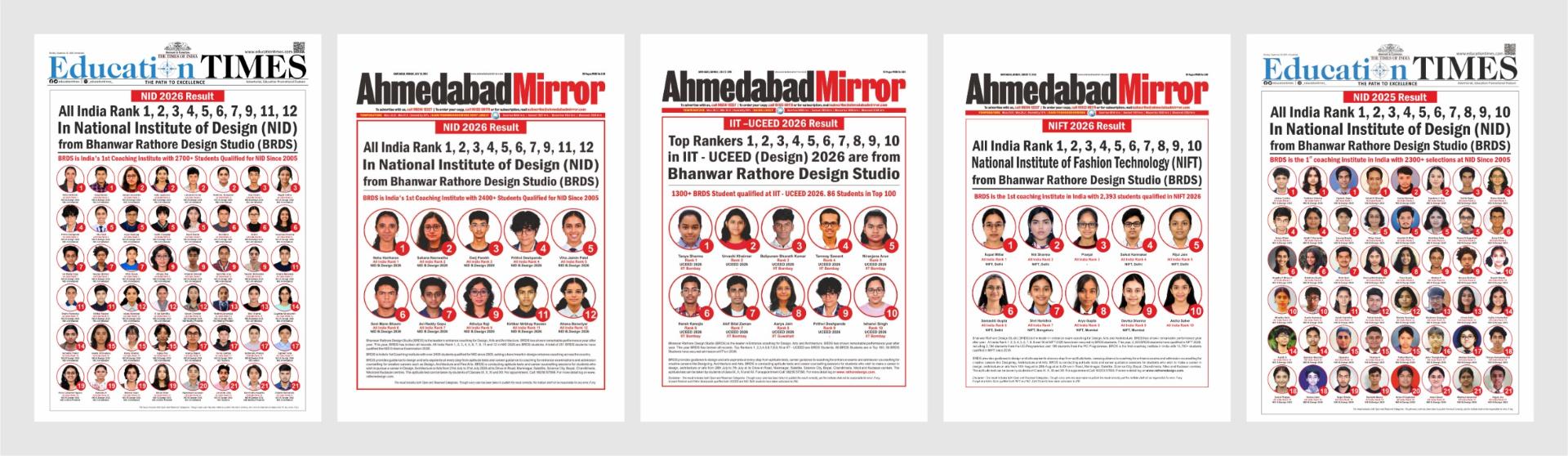
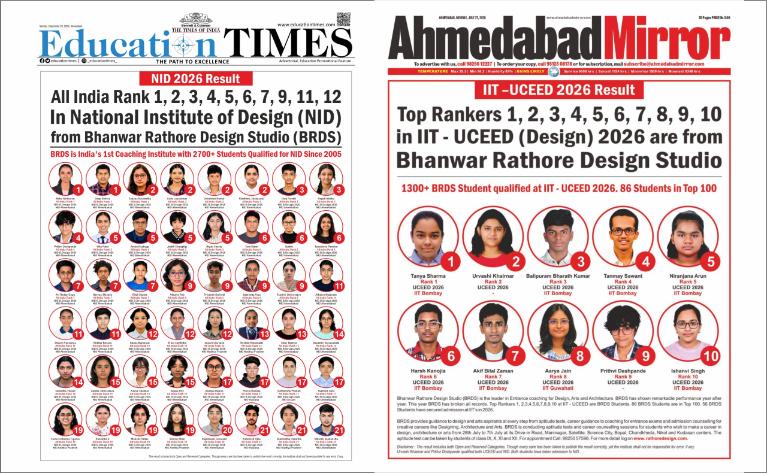
12 NIFT Result 2026
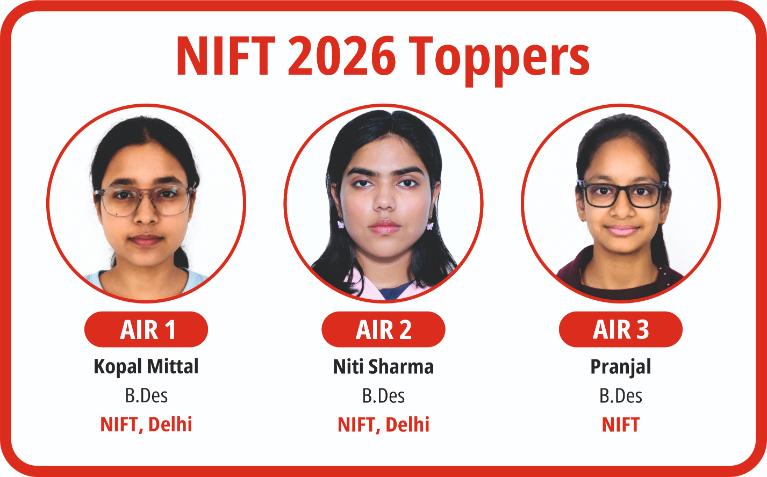
NIFT
Students Qualified in NIFT 2026
16,780 Total Qualified in NIFT Since 2005




14 Choosing a Design Direction
NIFT offers several very different design paths. Use this quick self-check to see which direction may suit your interests.
Clothing, silhouettes, and materials
Fashion Design
Branding, visual storytelling, and media
Fashion Communication
Colours, surfaces, and fabrics
Textile Design
Products, details, and materials
Accessory or Knitwear Design
Knitted structures and apparel
Knitwear Design
Spaces, retail environments, and visual experiences
Fashion Interiors
Technology, production, and apparel manufacturing
Apparel Production
NIFT preparation is therefore not limited to drawing. It requires students to develop the ability to observe, interpret, ideate, and communicate visual ideas.
15 Practice NIFTEE Questions
NIFTEE preparation involves different forms of reasoning, language ability, general awareness, and creative thinking. The examination structure differs by programme, so B.Des. and M.Des. aspirants should understand which components apply to their chosen programme.
B.Des. Practice Set
B.Des. candidates take GAT and CAT, and shortlisted candidates proceed to the Situation Test.
Choose the word closest in meaning to “versatile.”
“Versatile” describes someone or something capable of adapting to different uses, activities, or situations — closest to adaptable.
A fabric store offers 20% off on a jacket marked at ₹2,500. What is the sale price?
20% of ₹2,500 is ₹500, so the sale price is ₹2,500 − ₹500 = ₹2,000.
A display uses this repeating sequence: Circle → Triangle → Square → Star → Circle → Triangle → ? Which symbol comes next?
The sequence repeats every four symbols. After Circle and Triangle, the third position is Square.
Which Indian city is widely known as a major centre for the country’s textile and diamond industries?
Surat is an important centre for India’s textile and diamond industries.
A school bag must be redesigned for a student who travels by public transport every day.Sketch your concept on paper. There is no single right answer.
Create a quick visual concept showing:
- The main form of the bag
- One feature that improves everyday usability
- How that feature works
- A simple indication of material or colour
User needs, concept development, functional thinking, visualisation and communication.
M.Des. Practice Set
M.Des. candidates follow a different admission pathway. Students should refer to the relevant NIFTEE information for the applicable test components and subsequent selection stages.
Choose the sentence with the most appropriate use of the word “innovative.”
“Innovative” is an adjective meaning new and original. Only option A uses it correctly, to describe a new method.
A designer uses a 1:4 scale to represent a product that is originally 80 cm long. What will be the length of the scaled representation?
At a 1:4 scale, the representation is one-fourth of the original length: 80 ÷ 4 = 20 cm.
A product development team follows this sequence: Research → Define → Ideate → Prototype → Test. Which stage would logically come immediately after Ideate?
Prototyping allows a selected idea to be explored in a tangible form after the ideation stage.
Which organisation is responsible for conducting the NIFT Entrance Examination (NIFTEE)?
The National Testing Agency conducts NIFTEE on behalf of NIFT.
A public-space seating system must serve children, adults, and older users while occupying a small area.Sketch your concept on paper. There is no single right answer.
Create a visual concept showing:
- The basic form
- How different users can interact with it
- One feature that improves usability
- A simple indication of materials, proportions, or colour
User-centred thinking, spatial understanding, concept development, visualisation and communication.
What These Practice Sets Cover
| NIFTEE Area | Practice Focus |
|---|---|
| Communication Ability & English Comprehension | Vocabulary, language use and comprehension |
| Quantitative Ability | Numerical reasoning and accuracy |
| Analytical & Logical Ability | Inference, patterns and structured reasoning |
| General Knowledge & Current Affairs | General awareness and current information |
| CAT | Concept development, visualisation and creative communication |
NIFT identifies these four GAT areas as Communication Ability & English Comprehension, Quantitative Ability, Analytical & Logical Ability, and General Knowledge & Current Affairs. CAT is a separate creative component. For B.Des., shortlisted candidates proceed to the Situation Test after GAT and CAT; for M.Des., shortlisted candidates proceed to a Personal Interview.
16 FAQs
Is NIFT Coaching in Bangalore suitable for students from outside the city?
Yes. Students can choose among the BRDS Bangalore centres based on location, travel time, and batch availability.
What does NIFT preparation at BRDS include?
Preparation can include GAT practice, CAT drawing and ideation, visualisation, creative problem-solving, mock tests, time-bound exercises, and selection-stage practice. Exact inclusions vary by programme.
What is the NIFT B.Des. entrance process?
For the 2026 admission cycle, B.Des. admissions involved GAT and CAT in Stage 1, followed by the Situation Test for shortlisted candidates. Candidates should check the applicable year’s admission notice for future cycles.
Is NIFT only for students who want to become fashion designers?
No. NIFT offers programmes across areas including Fashion Design, Fashion Communication, Textile Design, Accessory Design, Knitwear Design, and Apparel Production.
Is there a NIFT campus in Bangalore?
Yes. NIFT Bengaluru is an official NIFT campus located in HSR Layout. It is separate from BRDS coaching centres.
What is the difference between NIFT Bengaluru and BRDS Bangalore?
NIFT Bengaluru is an official NIFT academic campus that offers undergraduate and postgraduate programmes. BRDS Bangalore provides coaching and preparation programmes for design entrance examinations.
Can students prepare for NIFT while studying in Class 11 or 12?
Yes. Early preparation can help students progressively develop drawing, observation, aptitude, and creative problem-solving skills alongside school studies.
What should I carry for NIFT preparation classes?
A sketchbook and basic drawing and craft materials are useful for regular practice. Exact requirements can vary by batch and activity.
Are the Bengaluru observation locations official NIFT practice venues?
No. They are suggested environments for independent observation and design practice. They are not official NIFT examination or coaching venues.
Where can I verify official NIFT admission information?
Candidates should check the official NIFT admissions website and the NIFTEE information issued by NIFT and NTA for eligibility, application dates, examination components, admit cards, results, and other admission instructions.
YOU CAN JOIN OUR BRANCHES
NIFT Coaching in Karnataka
NIFT Coaching in Malleswaram, Bangalore
Address: BRDS, No. 139, 2nd Floor, 8th Main, Between 13th and 15th Cross, Malleswaram, Bangalore, Karnataka 560055
Phone: 8980757598
NIFT Coaching in Jayanagar, Bangalore
Address: BRDS, No. 779 & 780, 4th Floor, Sai Tower, CNR Colony, South End Main Road, Jayanagar 9th Block, Bengaluru 560069
Phone: 8980757598
NIFT Coaching in Indiranagar, Bangalore
Address: BRDS, 2nd Floor, 488 Chinmaya Mission Hospital Road, 1st Stage, Opp. Fabindia, Indiranagar, Bangalore, Karnataka 560038
Phone: 8980757598