
NID Coaching in Delhi 2027-2028
1 NID Coaching in Delhi 2027 – 2028 at BRDS
Preparing for the National Institute of Design (NID) requires more than practising sketches. Aspirants need to develop creative thinking, observation, visualisation, material exploration, design awareness, problem-solving and the ability to communicate ideas effectively. For students searching for NID Coaching in Delhi, BRDS offers design entrance examination preparation that students can explore alongside independent practice, creative assignments, mock exercises and feedback-based learning.
BRDS lists centres across Delhi and the National Capital Region (NCR), including Malviya Nagar, Preet Vihar, Pitampura, Dwarka, South Extension, Karol Bagh and other locations. Students can compare these centres based on travel time, batch availability, course structure and individual preparation needs. Current addresses, course availability, fees and batch timings should be confirmed directly with BRDS before enrolment.
NID admissions are conducted through the NID Entrance Exam, the Design Aptitude Test (DAT). For the 2027–28 admission cycle, B.Des. and applicable integrated-pathway admissions include DAT Prelims, followed by DAT Mains for shortlisted candidates. Programmes and assessment components vary by admission route, so applicants should consult the relevant official admission handbook for eligibility, examination stages, weightage, deadlines and selection criteria.
NID entrance preparation generally involves creative ideation, observation drawing, visualisation, design problem-solving, material exploration and practice for the applicable DAT stages. Students can enquire about BRDS programmes covering these areas, including practical design exercises and mock assessments where applicable. The exact course structure and inclusions should be confirmed with the centre.
For students comparing options for NID Coaching in Delhi, the capital offers opportunities to observe historic architecture, traditional markets, contemporary retail, public transport, museums, public spaces and urban infrastructure. These surroundings can become useful starting points for independent design observation and creative exercises.
2 NID Entrance Coaching – Courses offered by BRDS
NID – Foundation Coaching
NID B.Design Coaching
NID M.Design Coaching
NID DAT Mains ( Studio Test ) Coaching
( B.Design / M.Design )
NID DAT Mains
Studio test , Interview & Portfolio preparation
Duration : 10 Days / 14 Days / 1 Month
3 Important Information about NID
About NID
About NID – National Institute of Design
The National Institute of Design (NID) is one of India’s leading institutions for design education and research. NID Ahmedabad, along with its extension campuses at Gandhinagar and Bengaluru, is recognised as an Institute of National Importance under the NID Act, 2014. It functions as an autonomous institute under the Department for Promotion of Industry and Internal Trade (DPIIT), Ministry of Commerce & Industry, Government of India.
In addition, National Institutes of Design are located in Andhra Pradesh, Haryana, Madhya Pradesh, and Assam. Admission to NID programmes is conducted through the Design Aptitude Test (DAT), comprising two stages — DAT Prelims and DAT Mains.
For the NID Admission 2027–28 cycle, the programme structure includes:
| Programme | Duration | Institute / Campus |
| Professional Education Programme – Master of Design (Integrated Pathway) | 5.5 Years | NID Ahmedabad, Gandhinagar & Bengaluru |
| B.Des. / Integrated M.Des. | 4 Years / 5.5 Years | NID Andhra Pradesh, Madhya Pradesh, Haryana & Assam, as offered by the respective institutes |
| Master of Design (M.Des.) | 2.5 Years | NID Ahmedabad, Gandhinagar & Bengaluru |
| M.Des. at other NIDs | As notified | NID Madhya Pradesh & NID Haryana |
Important Dates for NID Admission
NID Admission 2027–28 Important Dates
The following schedule is based on the official NID Admissions Handbooks 2027–28 for the B.Des./5.5-Year Integrated M.Des. and M.Des. programmes.
| Event | B.Des./5.5-Year Integrated M.Des. | M.Des. |
| Application Start Date | 10 September 2026 | 10 September 2026 |
| Last Date to Apply | 30 November 2026, 11:59 PM | 30 November 2026, 11:59 PM |
| Application Correction / Edit Window | 1–3 December 2026 | 1–3 December 2026 |
| Admit Card for DAT Prelims | 10 December 2026, 4 PM | 10 December 2026, 4 PM |
| DAT Prelims Exam | 20 December 2026 | 20 December 2026 |
| DAT Prelims Result | 16 March 2027, 4 PM | 16 February 2027, 4 PM |
| Re-totalling / Rechecking Window | 16–17 March 2027 | 16–18 February 2027 |
| Admit Card for DAT Mains | To be announced later | To be announced later |
| DAT Mains | To be announced later | To be announced later |
| DAT Mains Result | To be announced later | To be announced later |
| Admission Application / Seat Allotment | To be announced later | — |
| Admission Counselling, Fee Payment & Physical Verification | To be announced later | To be announced later |
Important: For B.Des., NID’s 2027–28 handbook describes the admission process as DAT Prelims → DAT Mains → separate admission application → seat allotment / admission counselling. Counselling and final admission are tentatively expected in June 2027, as NID has not officially announced the schedule.
For M.Des., the official handbook similarly lists the DAT Mains admit card, DAT Mains, DAT Mains result, re-totalling and admission counselling as “To be announced later.”
NID reserves the right to modify the admission schedule due to unforeseen circumstances. Candidates should regularly check the official NID admissions website.
NID Paper Pattern
NID Exam Pattern 2027
The NID DAT 2027 exam pattern consists of two stages:
Stage 1 – DAT Prelims and Stage 2 – DAT Mains.
The DAT Prelims score is used only to shortlist candidates for DAT Mains and is not carried forward as weightage into the final result.
NID Exam – B.Des. / Integrated Pathway
Stage 1: NID DAT Prelims
A paper-and-pencil/pen test. Questions may involve text and visuals, and the question paper will be in English only. The duration of the test is 3 hours. Candidates are shortlisted for DAT Mains on the basis of their DAT Prelims performance.
Stage 2: NID DAT Mains
| Part | Test |
| Part 1 | Studio Sensitivity Test |
| Part 2 | In-Person Sensitivity Test |
Studio Sensitivity Test – The DAT Mains Studio Sensitivity Test is a hands-on evaluation conducted at the NID campus. It may include drawing and sketching, 3D model-making, audio-visual exercises, responses to sensory stimuli, and group or individual interactions.
In-Person Sensitivity Test – This stage involves personal interaction with the candidateand include a portfolio review, allowing evaluators to understand the candidate’s creative thinking, design aptitude, interests, and approach to their work.
Important Note:
- For each category, approximately 2.5 times the number of available seats are shortlisted for DAT Mains.
- Only candidates who appear for both the Studio Sensitivity Test and the In-Person Sensitivity Test are considered eligible for the final merit list.
NID B.Des. Final Weightage 2027
| Stage 1 | DAT Prelims — used only for shortlisting candidates for DAT Mains | 0% |
| Stage 2 | DAT Mains Studio Sensitivity Test – 60% In-Person Sensitivity Test – 40% | 100% |
NID M.Des Exam Pattern
The Design Aptitude Test (DAT) for M.Des is also conducted in two stages:
Stage 1: NID DAT Prelims — Pen & Paper based written test
Stage 2: NID DAT Mains — Studio Test, Interview & Portfolio Review
- DAT Prelims (M.Des): Divided into objective and subjective sections with sketching. A single common test paper is used for all faculty streams at this stage.
- DAT Mains (M.Des): Divided into objective and subjective sections with sketching. A single common test paper is used for all faculty streams at this stage.
Stage 1: NID M.Des DAT Prelims
The NID M.Des DAT Prelims is also a paper and pencil/pen examination. Questions may involve text and visuals, and there will be a single common DAT Prelims test paper for the M.Des. programme.
The DAT Prelims score is used only for shortlisting candidates to DAT Mains and does not carry forward into the final result.
Stage 2: NID M.Des DAT Mains
Conducted at the NID campus and includes a faculty stream-specific Studio Test, a portfolio review, and discipline-wise interviews.
The Studio Test is conducted group-wise, except for Group X, where it is conducted discipline-wise. Separate interviews are conducted for each discipline.
Important Note:
- For NID M.Des., approximately 5 times the available seats in each category for each discipline are shortlisted for DAT Mains.
NID M.Des Final Weightage 2027
| Stage 1 | DAT Prelims — used only for shortlisting candidates for DAT Mains | 0% |
| Stage 2 | DAT Mains Studio Test – 40% Interview & Portfolio Review – 60% | 100% |
NID Application Form 2027
NID 2027 Application Form
How to Apply for NID 2027 Admissions
Candidates seeking admission to NID for the academic year 2027–28 must apply online through the official admissions portal: https://admissions.nid.edu.
Step 0: Read the Admissions Handbook
Before starting your application, go through the NID Admissions Handbook 2027–28 carefully. It covers:
- Eligibility criteria for each programme
- Seat availability and reservation policies
- Test centres for DAT Prelims & Mains
- Programme-wise admission requirements
Step 1: Registration
- Visit https://admissions.nid.edu and click on “Signup.”
- Select your programme, nationality, and category.
- Enter a valid email ID and mobile number — OTPs will be sent to both for verification.
- Use the login credentials sent to your email to access your application.
- Keep your registered contact details active until August 2027 — all official communication will be sent here.
- If you forget your password, use the “Forgot Password” option on the login page.
Step 2: Fill the Online Application Form
- Log in and complete all required personal, academic, and category-related information.
- You can make corrections during the official edit window, but Name, Date of Birth, Programme, Registered Mobile, and Email ID cannot be changed once submitted.
- Click ‘Save & Proceed’ to move to the document upload section.
Step 3: Upload Documents
Upload the following in the specified formats:
- Passport-size photograph: JPG/JPEG, 50–200 KB
- Signature: JPG/JPEG, 50–200 KB
- Category Certificates (if applicable): GEN-EWS, OBC-NCL, SC/ST/PwD — PDF, max 1 MB
- Overseas applicants: First and last page of a valid passport (PDF)
Step 4: Pay the Application Fee
| Category | Fee (INR) |
| General / GEN-EWS / OBC-NCL | ₹3,000 |
| Female Candidates (except SC, ST & PwD) | ₹2,000 |
| SC / ST | ₹1,500 |
| PwD / Third Gender | ₹500 |
| Overseas Applicants | US $125* |
* Fee amounts are based on the previous cycle and may be revised. Confirm on the official NID admissions portal when registration opens.
- Payment is accepted online via credit card, debit card, or net banking.
- After successful payment, download and save your application confirmation.
- Note: Application fees are non-refundable and non-transferable.
Step 5: Application Edit Window
- A limited-time window will be provided after the application deadline to review and correct your form (except for Name, Programme, Date of Birth, Mobile, and Email).
- NID reserves the right to reject incomplete or incorrect applications.
NID Admit Card 2027
NID DAT Admit Card 2027
The NID DAT Prelims Admit Card 2027 will be available for download from 4 PM on 10 December 2026 through the official NID admissions website. Candidates are responsible for downloading and printing their own admit cards before the examination.
The admit card will contain important details including the reporting time, test centre and examination instructions.
Important Notes
- Admit cards are issued only to candidates who have successfully submitted a complete application form.
- DAT Prelims and DAT Mains admit cards are issued separately — do not assume one covers both.
- Admit cards may not be reproduced or used by any person or institution without prior permission from NID, Ahmedabad.
How to Download the NID DAT Admit Card
- Visit the official admissions portal at https://admissions.nid.edu.
- Click on the admit card download link when it becomes active.
- Enter your registered Email ID, Date of Birth, and Application Number.
- View and download your admit card.
- Take a clear printout — you will need to carry it to the test centre.
Key Requirement
- A printed admit card is mandatory for entry to both DAT Prelims and DAT Mains. Candidates without a valid admit card will not be permitted to appear for the exam.
NID Cut Off 2027
NID Cut Off 2026-27 & Closing Ranks ( 2026- 2027)
All candidates must meet the NID DAT minimum qualifying marks to be considered for admission. The cut-off scores below are from the 2026–27 admission cycle for reference. Cut-offs for 2027–28 will be published after DAT Mains results are declared.
NID Minimum Qualifying Marks (DAT Mains)
| Programme | Open | Reserved Categories | |||||
| EWS | OBC-NCL | SC | ST | PwD | Overseas | ||
| B.Des | 50 | 50 | 45 | 40 | 40 | 40 | 50 |
| M.Des | 50 | 50 | 45 | 40 | 40 | 40 | 50 |
| Programme |
|---|
| M.Des Open : 50 EWS : 50 OBC-NCL : 45 SC : 40 ST : 40 PwD : 40 Overseas : 50 |
| B.Des Open : 50 EWS : 50 OBC-NCL : 45 SC : 40 ST : 40 PwD : 40 Overseas : 50 |
 NID B.Des 2026–27 — Closing Ranks and Scores of Last Candidate Admitted
Download Now
- NID M.Des 2026–27 — Closing Ranks and Scores of Last Candidate Admitted
Download Now
- NID B.Des 2025–26 — Closing Ranks and Scores of Last Candidate Admitted
Download Now
- NID M.Des 2025–26 — Closing Ranks and Scores of Last Candidate Admitted
Download Now
NID Result 2027
NID DAT Prelims Result Date 2027
NID DAT results are declared online only on the official admissions website: https://admissions.nid.edu. There are two separate result announcements — one for DAT Prelims and one for DAT Mains — published according to the schedule declared by NID each cycle.
Only candidates who clear the Prelims cut-off are shortlisted for DAT Mains. The final merit list is based entirely on DAT Mains performance. Candidates must log in using their registered email ID and date of birth to view and download their result.
How to Check NID DAT 2027 Result
- Visit the official result portal: https://admissions.nid.edu
- Click on the result login link
- Enter your registered email ID and date of birth
- Your result will appear on screen
- You should download or print your result for records
Important: Qualifying in NID DAT does not by itself guarantee admission. Final selection depends on merit rank, category, seat availability at each NID campus, and completion of document verification and fee payment formalities.
Result Dates :
- The B.Des./Integrated Pathway DAT Prelims result is scheduled for 16 March 2027 at 4 PM.
- The M.Des. DAT Prelims result is scheduled for 16 February 2027 at 4 PM.
4 BRDS in Delhi’s Creative Ecosystem for NID Preparation
Delhi brings together historic monuments, planned commercial districts, traditional markets, public transport networks, museums, contemporary architecture and diverse neighbourhoods. For aspiring designers, these settings offer opportunities to study how people interact with products, signs, materials, buildings and public services.
For students exploring NID coaching in Delhi, the wider city can serve as an informal observation studio. The objective is to look beyond the appearance of an object or place and understand its function, usability, visual communication and relationship with its users.
| Delhi Observation Environment | Possible Design Observation Focus | General Area |
|---|---|---|
| Chandni Chowk & Old Delhi Markets | Product displays, packaging, signage, colour, customer movement and use of limited space. | Old Delhi |
| Connaught Place | Commercial signage, typography, retail displays, wayfinding and pedestrian circulation. | Central Delhi |
| Dilli Haat | Handcrafted products, material choices, traditional patterns, product presentation and cultural influences. | INA |
| Lodhi Art District | Murals, colour relationships, visual storytelling, public art and the use of walls as communication surfaces. | Lodhi Colony |
| India Gate & Kartavya Path | Public-space planning, pedestrian movement, landscape composition and interaction with public infrastructure. | Central Delhi |
| National Crafts Museum | Craft traditions, material use, surface patterns, object construction and cultural design references. | Pragati Maidan area |
| Khan Market | Retail layouts, branding, packaging, signage and customer navigation. | Central Delhi |
| Hauz Khas Village | Adaptive use of buildings, visual identity, retail environments and the relationship between historic structures and contemporary businesses. | South Delhi |
| Humayun’s Tomb & Its Gardens | Symmetry, proportion, geometry, material details, landscape design and spatial organisation. | Nizamuddin area |
| Delhi Metro Stations & Interchanges | Wayfinding, signage, accessibility, passenger movement and service design. | Across Delhi and NCR |
Traditional shopping areas in Delhi are useful for observing how products are displayed, handled, packaged and selected. Students can compare these environments with organised retail spaces to understand differences in navigation, visual hierarchy, customer movement and product presentation.
Historic buildings and public spaces provide another starting point for design thinking. Students can study repetition, proportion, texture, scale and the relationship between built structures and their surroundings. Everyday transport experiences can also reveal how people navigate spaces, where congestion occurs and which design changes could improve accessibility.
Disclaimer: BRDS lists centres across Delhi and the National Capital Region, including Malviya Nagar, Preet Vihar, Pitampura, Dwarka, South Extension, Karol Bagh, Janakpuri West, GTB Nagar, Noida Sector 2, Greater Noida, Ghaziabad, Gurugram and Faridabad. The availability of a particular course may vary by centre. Students should confirm the current address, course availability, fees and batch timings directly with BRDS before visiting. These are BRDS locations for design entrance examination preparation, not NID campuses or official NID examination venues. The observation locations above are suggested environments for independent practice, not NID-affiliated venues.
5 Turning Everyday Observation into NID Practice
A visit becomes more useful when students approach it with a design question instead of simply collecting photographs. Turn every Delhi outing — a Chandni Chowk lane, a Connaught Place arcade, a Metro interchange, Humayun’s Tomb — into a live design brief.
What attracts attention first in this space, and why?
How does colour influence the way people perceive a product?
Which signs are easy or difficult to understand?
How are products arranged to influence customer attention?
What makes a particular object comfortable or uncomfortable to use?
Which shapes, textures and patterns repeat in the environment?
Where do people stop, wait or change direction?
How could an everyday object be redesigned for a different user?
Can the same object be represented through different viewpoints?
What changes would make a public space more accessible?
For example, observe a crowded market counter and sketch three alternative layouts that improve visibility and movement. Or study seating in a public space and develop a concept that makes it more comfortable for children, adults and older people.
This approach turns everyday Delhi surroundings into a continuing source of NID DAT preparation — helping students connect observation with practical design decisions.
6 NID Preparation at BRDS Delhi
A structured NID entrance preparation programme can help students organise their practice across different aspects of design aptitude. Preparation should reflect the admission process applicable to the candidate’s chosen programme and current examination cycle.
Creative & Visual Practice
- Observation drawing and sketching
- Visualisation and perspective
- Creative ideation and concept development
- Composition and visual storytelling
- Colour, form, texture and material exploration
- Design problem-solving
- Three-dimensional thinking
- User-centred design
- Time-bound creative exercises
The purpose is not simply to produce attractive drawings. Candidates should learn to communicate a clear idea, understand a design problem, consider the needs of users and explain how a proposed solution works.
Design Aptitude Preparation
- Visual reasoning and pattern recognition
- Observation and interpretation
- Spatial understanding
- Creative problem-solving
- Analytical thinking
- Understanding objects, materials and their functions
- Interpreting visual information
- Communicating ideas through words and drawings
The format and assessment areas can differ across DAT Prelims, DAT Mains and individual programmes. Students should consult the applicable official NID Admissions Handbook instead of relying on a fixed or assumed question pattern.
DAT Mains & Studio Test Preparation
- Developing a concept from a design brief
- Exploring different solutions to the same problem
- Creating three-dimensional forms or models
- Working with paper and other basic materials
- Responding to visual or sensory prompts
- Explaining design decisions
- Presenting ideas clearly during an interaction
Candidates shortlisted for DAT Mains may need to demonstrate how they respond to practical design challenges. The exact format depends on the programme and admission cycle, so follow the official instructions rather than assuming every year uses the same tasks or materials.
7 Essential Materials for NID Preparation
Good NID Study Material should support both visual practice and design problem-solving. A basic preparation kit can include drawing tools, paper, colouring materials and supplies for exploring three-dimensional forms.
| Material | Use in NID Preparation |
|---|---|
| Sketchbook | Daily observation drawing, ideation and visual notes |
| HB, 2B & 4B Pencils | Sketching, tonal studies and form development |
| Eraser & Sharpener | Corrections and clean sketching |
| Fine Liners | Outlines, detailing and visual communication |
| Colour Pencils | Colour studies and rendering |
| Markers | Quick visualisation and presentation practice |
| A4/A3 Drawing Sheets | Timed drawing and creative exercises |
| Tracing Paper | Exploring variations and refining ideas |
| Craft Paper & Cardboard | Paper construction and basic model-making |
| Scissors | Cutting and construction exercises |
| Glue | Joining materials during model-making practice |
| Clay | Exploring three-dimensional forms |
| Masking Tape | Temporary assembly and model construction |
| Scale & Ruler | Measurement, proportion and layout exercises |
| Recycled Materials | Exploring sustainable design and alternative uses for everyday objects |
Material requirements may vary depending on the activity and programme. Candidates should follow the official examination instructions for the relevant admission cycle. The official NID admissions website provides admission handbooks and examination-related information, and candidates should use the relevant handbook and official updates to understand the applicable process.
8 NID B.Des. Career Opportunities and Industry Scope
NID offers design education across disciplines connected to product development, communication, digital experiences, lifestyle products and other design-related fields. The programmes available depend on the campus and admission pathway. Design education can lead to roles in which professionals research user needs, develop concepts, create prototypes, communicate information and improve the usability or appearance of products and services.
| Career Area | Possible Roles | Industry Areas |
|---|---|---|
| Product Design | Product Designer, Industrial Designer, Design Researcher | Consumer products, appliances, manufacturing, technology |
| Communication Design | Graphic Designer, Visual Communication Designer, Brand Designer | Advertising, publishing, branding, digital media |
| Interaction & Digital Design | UI Designer, Interaction Designer, Experience Designer | Technology, digital products, software, services |
| Textile & Lifestyle Design | Textile Designer, Surface Designer, Lifestyle Product Designer | Textiles, home furnishings, fashion, lifestyle products |
| Furniture & Spatial Products | Furniture Designer, Product Developer | Furniture, interiors, manufacturing, retail |
| Animation & Digital Media | Animator, Visual Development Artist, Multimedia Designer | Animation, entertainment, gaming, digital content |
| Design Research | Design Researcher, User Researcher, Design Strategist | Consulting, technology, consumer research, innovation |
Career opportunities depend on the student’s chosen discipline, portfolio, technical skills, internships and professional interests. Students should check the official programme listings for the campuses and disciplines available in their admission year.
9 Why Choose BRDS For NID Preparation?
BRDS India’s No. 1 NID Coaching Institute:
BRDS is proud to announce that BRDS has the Highest selection of students in NID this year as compared to any coaching institute in India.
Top Reasons for every parent & student to know, Why Join BRDS for NID Preparation?
1) BRDS has the Highest NID Results – 275 Students Qualified NID 2026
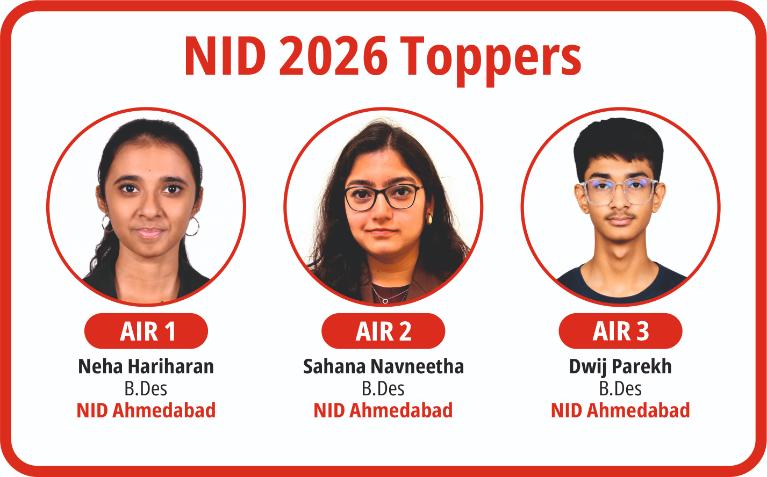
2) BRDS Produced AIR 1 in NID B.Des 2026 – Neha Hariharan
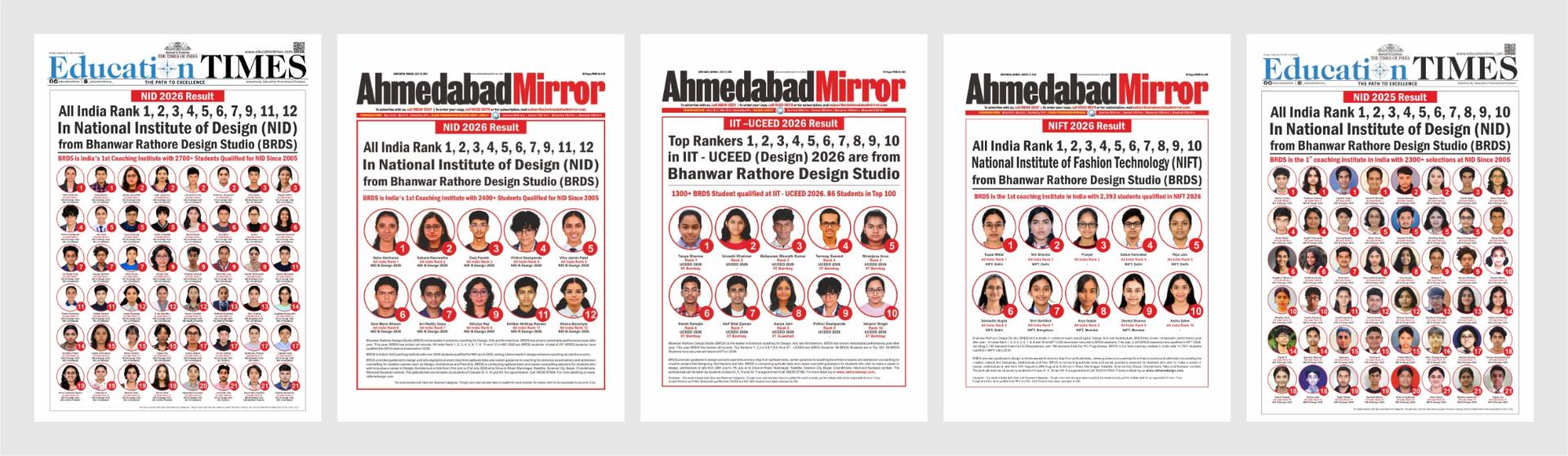
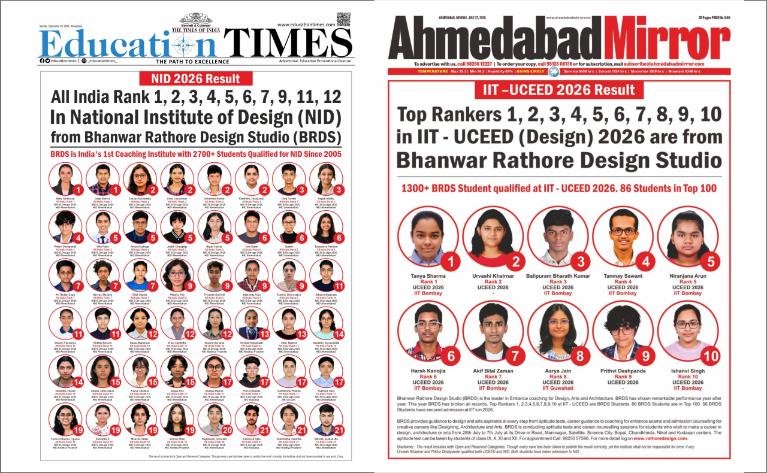
3) All India Ranks 1, 2, 3, 4, 5, 6, 7, 9, 11, 12 in NID 2026 are from BRDS
4) 72 BRDS Students in Top 100 All India Ranks in NID 2026
5) 214 BRDS Students Allotted Seats in NID B.Des & M.Des Courses in 2026
6) BRDS has 2,712+ Cumulative NID Selections Since 2005
7) BRDS Provides the Best NID Study Material Developed by Expert Faculty
8) BRDS Conducts Regular Mock Tests, Portfolio Guidance & Personal Mentoring Sessions
9) BRDS Provides Comprehensive Training for DAT Prelims, DAT Mains & Studio Test
10 BRDS NID Result
NID
Students Qualified in NID 2026
2,712 Total Qualified in NID
Since 2005





13 Choosing a Design Direction
NID prepares students for several very different design paths. Use this quick self-check to see which direction may suit your interests.
Everyday objects, functionality and problem-solving
Product Design
Typography, graphics and visual storytelling
Communication Design
Digital products, user behaviour and interfaces
Interaction & Digital Design
Fabrics, surfaces and patterns
Textile & Lifestyle Design
Furniture, materials and spatial usability
Furniture & Spatial Products
Motion, storytelling and digital imagery
Animation & Digital Media
Research, observation and understanding people
Design Research
NID preparation is therefore not limited to drawing. It involves learning to observe, interpret, ideate, test and communicate design solutions.
14 Practice NID Entrance Exam Questions
Before joining a preparation programme, experience the type of thinking involved in design aptitude preparation. Try the three questions below to feel the range of NID DAT-style reasoning.
A cube has all six faces painted. It is then divided into 27 equal smaller cubes. How many smaller cubes have paint on exactly two faces?
When the large cube is divided into 27 equal cubes, it forms a 3 × 3 × 3 arrangement. The smaller cubes with paint on exactly two faces are found along the edges of the large cube, but not at the corners.
Each of the large cube’s 12 edges has three smaller cubes along it. The two cubes at the ends are corner cubes, which have paint on three faces. This leaves one middle cube on each edge with paint on exactly two faces.
12 edges × 1 qualifying cube per edge = 12 cubes
A public drinking-water station is frequently used by children, elderly people, and wheelchair users. Which design consideration should be prioritised first?
Design begins with understanding the user and the problem. A solution should first address accessibility, usability, and the needs of different users before decorative considerations.
Which observations can help a designer understand how people interact with a railway station?Select all that apply.
These observations reveal behaviour, movement, wayfinding, and potential user problems. Colour and advertising may also be observed, but the question focuses specifically on understanding passenger interaction with the station.
What These Questions Test
| Question Type | Skill Being Practised |
|---|---|
| NAT — Numerical Answer Type | Numerical reasoning and spatial thinking |
| MCQ — Multiple Choice Question | Design thinking and problem identification |
| MSQ — Multi-Select Question | Observation and interpretation |
This is how design aptitude preparation can move beyond memorisation. Students can enquire about preparation activities that develop problem identification, interpretation, idea generation and the ability to communicate their reasoning.
What These Practice Sets Cover
| Design Aptitude Area | Practice Focus |
|---|---|
| Observation & Visual Reasoning | Recognising forms, interpreting visual information and understanding relationships |
| Creative Problem-Solving | Developing practical solutions to everyday problems |
| Spatial & Functional Thinking | Understanding form, usability, proportion and accessibility |
| Sustainable Design | Exploring material reuse and responsible design decisions |
| Design Research | Identifying user needs and investigating problems |
| Design Communication | Explaining concepts through sketches, diagrams and written notes |
| Concept Development & Evaluation | Creating, testing and refining design solutions |
15 Why Consider NID?
For students interested in a career in design, the National Institute of Design offers education across several design disciplines and campuses. The available programmes, disciplines and admission routes differ by institute.
Delhi does not have an NID campus. Students preparing in Delhi can explore the official NID campuses and programmes listed in the current admission handbook before choosing which programme and institute to target.
NID Bengaluru is a postgraduate design campus offering Master of Design programmes in areas including Design for Retail Experience, Digital Game Design, Information Design, Interaction Design and Universal Design. Other NID campuses offer different undergraduate, integrated and postgraduate pathways, depending on the admission year.
Delhi’s media, advertising, publishing, retail, technology, handicrafts and startup environments provide useful contexts for exploring how design is applied to products, digital experiences, services and user needs. These industries can also help students understand the different directions a design education may lead to.
The official NID website and NID admissions portal should be consulted before deciding which campus or discipline to target. Admission depends on meeting the applicable eligibility criteria, performing in the required assessment stages and completing subsequent admission formalities.
For aspiring designers preparing in Delhi, the city’s historic architecture, traditional markets, public transport systems, cultural institutions and contemporary commercial districts can provide useful contexts for independent observation and design exploration.
16 FAQs for Delhi Students
Is the National Institute of Design a government institution?
Yes. NID is an autonomous design education and research institution under the Department for Promotion of Industry and Internal Trade (DPIIT), Ministry of Commerce and Industry, Government of India.
Is DAT Prelims enough to secure admission to NID?
No. DAT Prelims is used to shortlist candidates for the subsequent assessment stage. Candidates must complete the applicable DAT Mains and admission requirements. Clearing a preliminary stage alone does not guarantee admission.
Are NID institutes the same as BRDS Delhi?
No. NID institutes are official National Institute of Design campuses. BRDS Delhi refers to separate coaching centres offering design entrance preparation. NID states that it does not authorise or franchise coaching providers to conduct its admission test classes. Students should distinguish independent preparation services from official NID programmes.
Can students from any stream apply for NID undergraduate design programmes?
Candidates from different academic streams may be eligible, subject to the prescribed educational qualifications and other conditions. Applicants should consult the relevant 2027–28 Admissions Handbook for the exact eligibility requirements.
How long is the NID undergraduate design programme?
The programme structure depends on the admission route and campus. The 2027–28 admissions portal lists B.Des. and a 5.5-year Professional Education Master of Design Integrated Pathway. Candidates should consult the applicable handbook for the duration and structure of their chosen programme.
Are all NID campuses offering the same design programmes?
No. Programme availability varies by campus. The official admissions portal lists different programme options across NID Ahmedabad, Gandhinagar, Bengaluru, Madhya Pradesh, Haryana, Andhra Pradesh and Assam for the 2027–28 admission cycle.
Where is the official NID DAT application form available?
Applications are submitted through the official NID admissions portal. Applicants should use the portal and the relevant admissions handbook for current application requirements.
Does NID officially authorise private coaching institutes?
NID states on its official admissions website that it does not encourage coaching classes for preparation for its admission test and has not authorised or franchised any organisation to conduct such classes. Students should not interpret a coaching provider’s claims as official NID endorsement.
Where can candidates check the NID DAT Prelims date for 2027–28?
Candidates should consult the official NID Admissions 2027–28 portal for the published examination schedule and any subsequent amendments.
Where can candidates find NID DAT sample papers?
Candidates can check the official NID admissions portal for sample test papers and other examination resources when they are made available for the relevant admission cycle.
YOU CAN JOIN OUR BRANCHES IN DELHI NCR
NID Coaching in Delhi NCR
BRDS Centres in Delhi & NCR
Delhi: Malviya Nagar, Preet Vihar, Pitampura, Dwarka, South Extension, Karol Bagh, Janakpuri West, GTB Nagar
NCR: Noida Sector 2, Greater Noida, Ghaziabad, Gurugram, Faridabad
Phone: 8980757598
Course availability, fees and batch timings vary by centre. Please confirm current details with BRDS before visiting.
For Any Enquiry
If you have any query and doubts feel free to mail us info@rathoredesign.com
Please note : BRDS centres are listed for design entrance examination preparation only. They are not NID campuses or official NID examination venues.